A model-fit engineering notebook

Size an LLM server around the model, memory and service pattern.

A local model that loads successfully has not yet passed a workload test. The useful sizing envelope combines the exact model build with quantisation, working context, active sequences, runtime behaviour and operating headroom.

Decision in one minute

Use this page when model fit is the main question. Start with the smallest model that meets the accepted task, then prove memory and service behaviour.

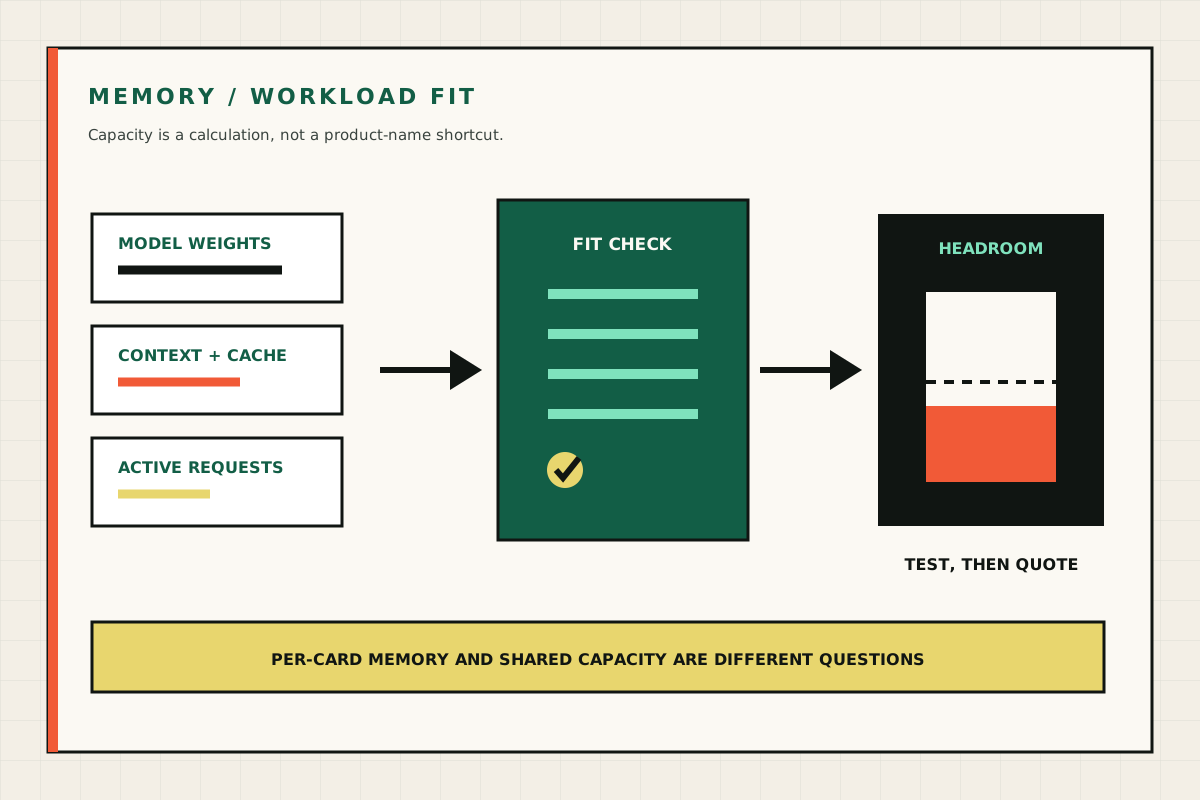
Diagram combining model weights, context, cache and active requests into a memory headroom check
Memory fit depends on the workload, context, cache and simultaneous demand, then needs a representative test. Original explanatory plate. It sets out a decision method, not a measured result.
Memory fit depends on the workload, context, cache and simultaneous demand, then needs a representative test.

LLM model-fit notebook

Build the memory envelope before naming the server.

A local LLM deployment is shaped by more than parameter count. The model build, quantisation, context, KV cache, active sequences and runtime must fit together with operational headroom.

  1. 01

    Model and quantisation

    Record the exact model build and precision rather than relying on a family name or parameter headline.

  2. 02

    Context and cache

    Test the working context and KV cache required by the real documents, prompts and output lengths.

  3. 03

    Active sequences

    Measure overlapping requests. A model that fits for one user can fail when several sequences stay active.

  4. 04

    Runtime and topology

    Decide whether the service needs one GPU, independent workers or supported model parallelism.

  5. 05

    Operational headroom

    Leave room for monitoring, updates and demand variation, then retain the tested configuration.

Runtime starting points

The serving profile changes the hardware test.

LLM runtime starting fit and evidence requirements
Runtime Useful starting fit Evidence to retain
Ollama Approachable managed model use and smaller team deployments Pinned model, API behaviour, access boundary and representative task
vLLM Higher-throughput LLM serving and OpenAI-compatible endpoints Concurrency, latency, throughput, cache use and failure behaviour
llama.cpp Flexible quantised inference across varied hardware Exact build, offload, context, tokens per second and output quality
Exploded supplier render of passive GPUs arranged above an open 4U rack chassis
Supplier layout render used to explain GPU density and airflow. It does not represent a confirmed package configuration. OEM supplier reference image. Written reuse permission pending.
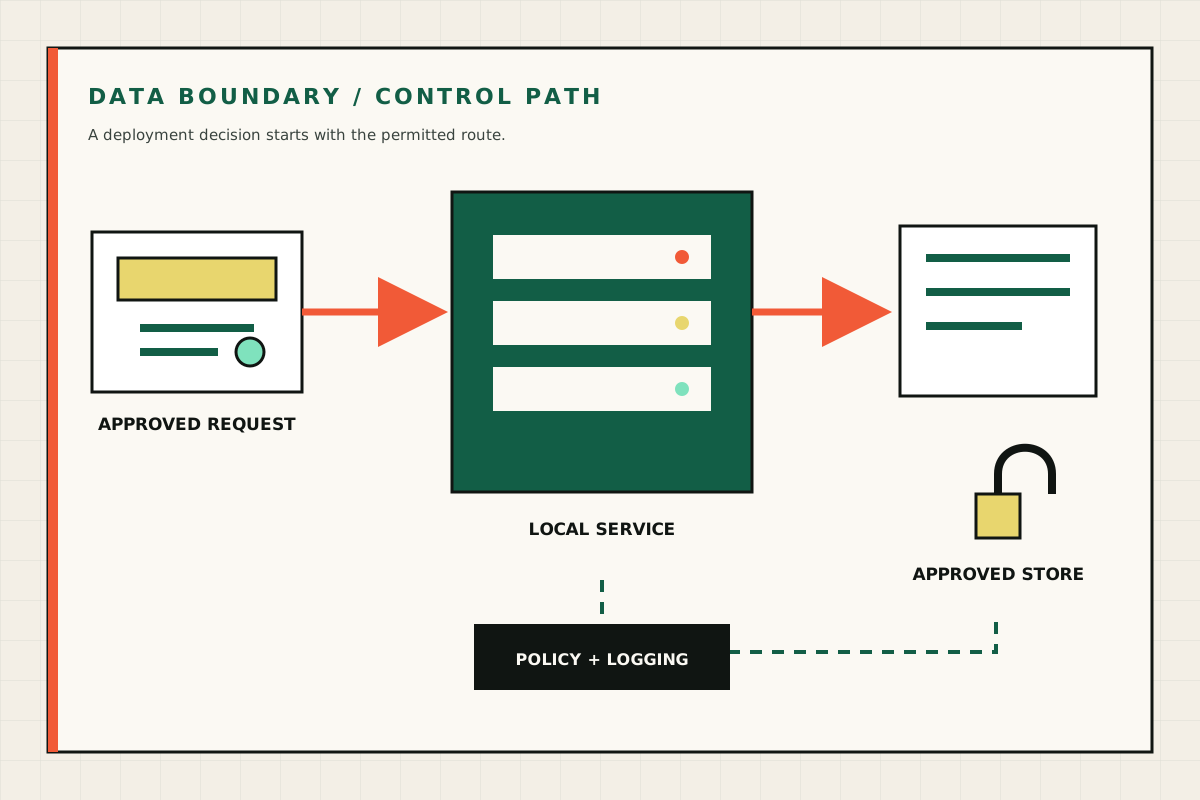
Diagram showing an approved request, a local service, an approved store and a policy-controlled data path
A private deployment starts with the permitted data path, access policy and logging boundary. Original explanatory plate. It sets out a decision method, not a measured result.
Open 4U OEM GPU server chassis showing passive GPUs, cooling fans, processors and memory slots
OEM supplier render showing one possible internal layout. Components vary with the ordered build. OEM supplier reference image. Written reuse permission pending.
Notebook entry 01

Parameters are only the beginning

Model weights consume VRAM, but so do context, KV cache, batch size and concurrent sequences. Runtime overhead and quantisation format change the result again.

A useful test set contains representative questions, source documents and expected answers. Quality, latency and resource use are measured together.

Notebook entry 02

Single GPU, several workers or model sharding

One high-memory GPU is the simplest execution target. Several GPUs can serve independent models or users efficiently. A larger model can be split only where the runtime and topology support it.

The website therefore states per-GPU and aggregate VRAM, and never markets aggregate memory as universally pooled.

Notebook entry 03

Ollama, vLLM and llama.cpp are different tools

Ollama is approachable for managed model use and smaller deployments. vLLM is designed for higher-throughput serving. llama.cpp gives flexible quantised inference across many platforms.

The chosen profile is pinned and documented. A name in a package list is not evidence that every workload will behave the same way.

Notebook entry 04

A local model is not automatically a hosted frontier equivalent

Local open models can be excellent for retrieval, summarisation, extraction, coding and structured workflows. They may not match the strongest hosted models on every reasoning or multimodal task.

A hybrid route can preserve a deliberate frontier-model path while keeping routine or sensitive work local.

Questions answered

Straight answers to common questions

How much VRAM does an LLM server need?

It depends on model weights, quantisation, context, batch size, concurrency and runtime. Start with a measured workload and use the VRAM guide rather than a single parameter-to-memory rule.

Can several GPUs combine their VRAM?

Some runtimes can divide supported models across GPUs, but the result depends on software and interconnect. Aggregate VRAM is not a universal pool.

Will a private AI server always be cheaper than cloud AI?

No. SaaS is usually the better-value choice for a small team with light or irregular use. Owned capacity becomes more credible when privacy, offline operation, many shared users or sustained workloads have independent value. We show the comparison rather than forcing the server answer.

Primary-source register

Check the live rule or price before relying on it.

Reviewed 26 July 2026. These links support the dated statements on this page; they do not replace legal, tax, security or professional advice.

Resolve the model-fit question

Bring one model, one task and one demand profile to the sizing brief.

The useful output is a testable memory and runtime profile, not a universal claim about a parameter count.