Physical rack hardware to buy and own

Physical GPU servers engineered for sustained rack workloads.

This page is about customer-owned rack hardware rather than hourly GPU hosting. It examines the accelerator plane, host platform, airflow, power and management path that make sustained multi-GPU operation credible.

Decision in one minute

Choose a rack GPU server when density, independent workers, remote management and serviceability justify the facility. Choose a workstation when office practicality matters more.

Three-quarter supplier render of a 4U OEM multi-GPU rack server
OEM platform reference render. It is not evidence of a completed customer build or final specification. OEM supplier reference image. Written reuse permission pending.
OEM platform reference render. It is not evidence of a completed customer build or final specification.

Physical GPU server inspection

The chassis earns its place line by line.

A rack GPU server is a physical infrastructure purchase. GPU density matters, but so do PCIe topology, per-card memory, cooling, power delivery, remote management and the room around the machine.

  • 01

    Accelerator plane

    How many GPUs, with what per-card VRAM and lane allocation?

    Exact cards, slots, lanes and execution pattern recorded
  • 02

    Host platform

    Will CPU, ECC memory, storage and network feed the workload?

    Named bill of materials and workload path
  • 03

    Thermal path

    Can the chassis and room remove heat under sustained load?

    Burn-in conditions, temperatures and site checks
  • 04

    Power path

    Are circuits, protection, connectors and UPS policy suitable?

    Electrician or facilities confirmation where required
  • 05

    Service path

    Can the system be monitored, recovered and physically maintained?

    Management access, spares and handover ownership
Open 4U OEM GPU server chassis showing passive GPUs, cooling fans, processors and memory slots
OEM supplier render showing one possible internal layout. Components vary with the ordered build. OEM supplier reference image. Written reuse permission pending.
Hot-swap GPU server cooling fan module with a pull handle and protective grille
Supplier component image showing a removable cooling fan module. Service terms and spare-part availability require written confirmation. OEM supplier reference image. Written reuse permission pending.
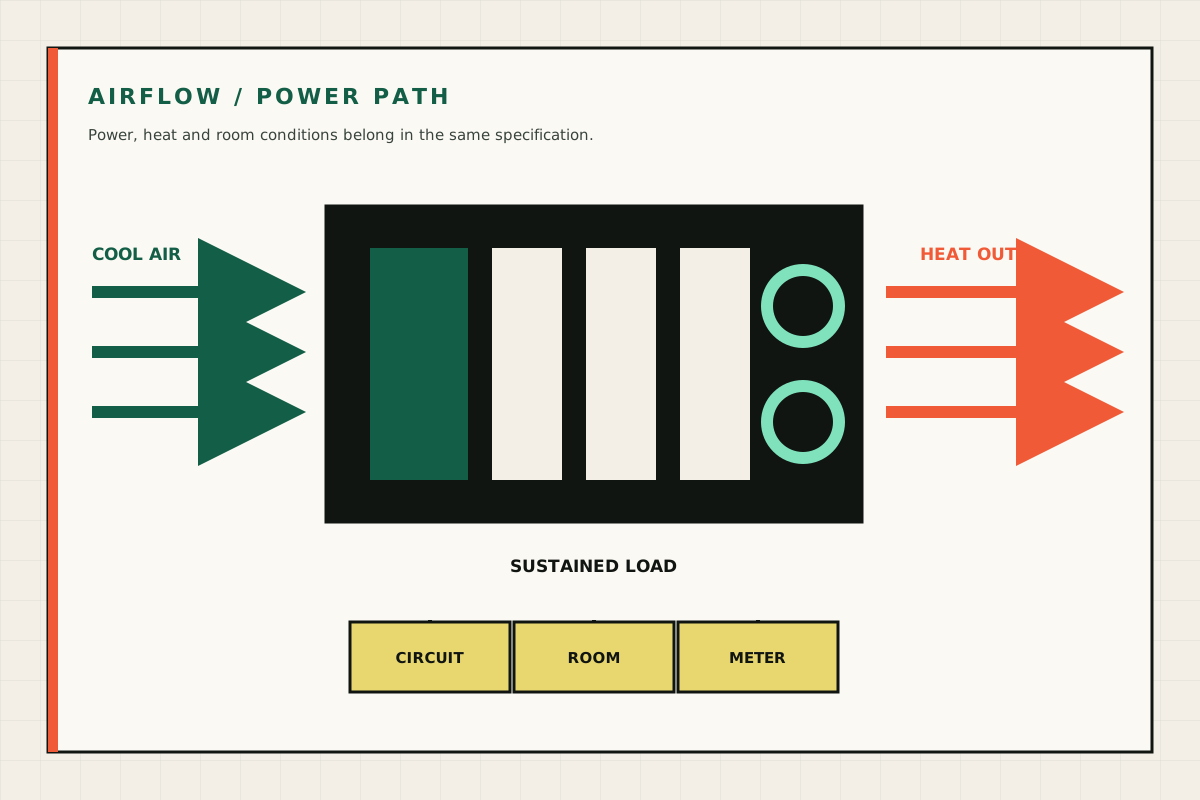
Diagram of cool air entering a rack server, heat leaving it and checks for the circuit, room and meter
Power, airflow and room conditions form one site-readiness decision rather than three separate afterthoughts. Original explanatory plate. It sets out a decision method, not a measured result.

Specification notes

Hardware decisions that remain visible after the GPU headline.

Each note belongs in the fit brief, quotation or acceptance record. It should not disappear into generic product copy.

01 / 04

What makes a GPU server different?

A serious multi-GPU server combines a server CPU platform, ECC system memory, appropriate PCIe lanes, high-airflow cooling, remote management, storage and power designed for sustained load. It is not simply a mining chassis with newer cards.

The proposed platforms support multiple GPU workers and, where the software and model support it, tensor or pipeline-parallel inference. The execution pattern must be tested rather than inferred from aggregate VRAM.

  • 4U rack form factor with front-to-rear airflow
  • AMD EPYC server platforms and ECC memory
  • 10GbE baseline and IPMI remote management
  • Hot-swap, redundant power on the larger platforms
02 / 04

GPU memory is the first sizing conversation

Two 24GB GPUs are not automatically the same as one 48GB GPU. Four 32GB GPUs are not automatically one 128GB GPU.

Per-GPU VRAM constrains what can run on a single card. Aggregate VRAM matters only when the runtime can divide a workload effectively or when several independent services use separate cards.

Context length, KV cache, batch size and concurrent requests also consume memory. That is why a model name alone is not enough to size a server.

03 / 04

Power, heat and noise are part of the specification

The proposed range spans roughly 1kW to 3.3kW planning loads before cooling overhead. Actual consumption depends on the chosen parts and workload. A site pre-flight must confirm circuits, rack, ventilation, room temperature, internet, noise tolerance and UPS policy.

If the server cannot be housed responsibly, a tower workstation, colocation or cloud service is the better answer.

04 / 04

Built to order rather than stocked speculatively

Final supplier cost, GPU availability and currency move quickly. We therefore propose a documented fit check, exact bill of materials, time-limited quote and 60% deposit before procurement.

This reduces stock risk and makes substitutions visible. The customer receives the agreed configuration - not a near-enough build hidden behind a generic product title.

Questions answered

Straight answers to common questions

Do you rent GPU servers?

The core proposition is physical hardware supplied for the customer to own. Optional marketplace hosting is a separate, opt-in assessment for genuinely spare capacity and is never guaranteed.

Can a GPU server sit in an ordinary office?

Some smaller systems may, but the proposed rack range has meaningful heat and noise. Business 128 and Scale 384 should be treated as server-room or colocation equipment unless an acoustic and thermal solution is designed.

Why not reuse an old mining server?

Mining systems often have limited CPU, RAM and PCIe bandwidth. They can still be useful for independent workers, rendering or batch tasks, but should not be presented as modern coherent multi-GPU LLM platforms without evidence.

Resolve the hardware question

Put the exact chassis, room and acceptance checks in one record.

The configuration route captures the workload and facility before the final bill of materials, quote and test plan are agreed.